[2878 words]
She is on the phone with a man who is explaining to her when her deadline is, and she is explaining to him that she knows when her own deadline is, and he is not listening. They have been on the phone for 38 minutes talking about her deadline, and her patience is thinning and so she spins around once in her favorite desk chair, hastily thanks him, and hangs up the phone. She is a writer, she thinks, so why can’t he let her write? This is her agent, but she does not like him; she knows she will have to fire him soon—but her deadline is next week, and she can’t bring herself to take decisive action until the draft is in.
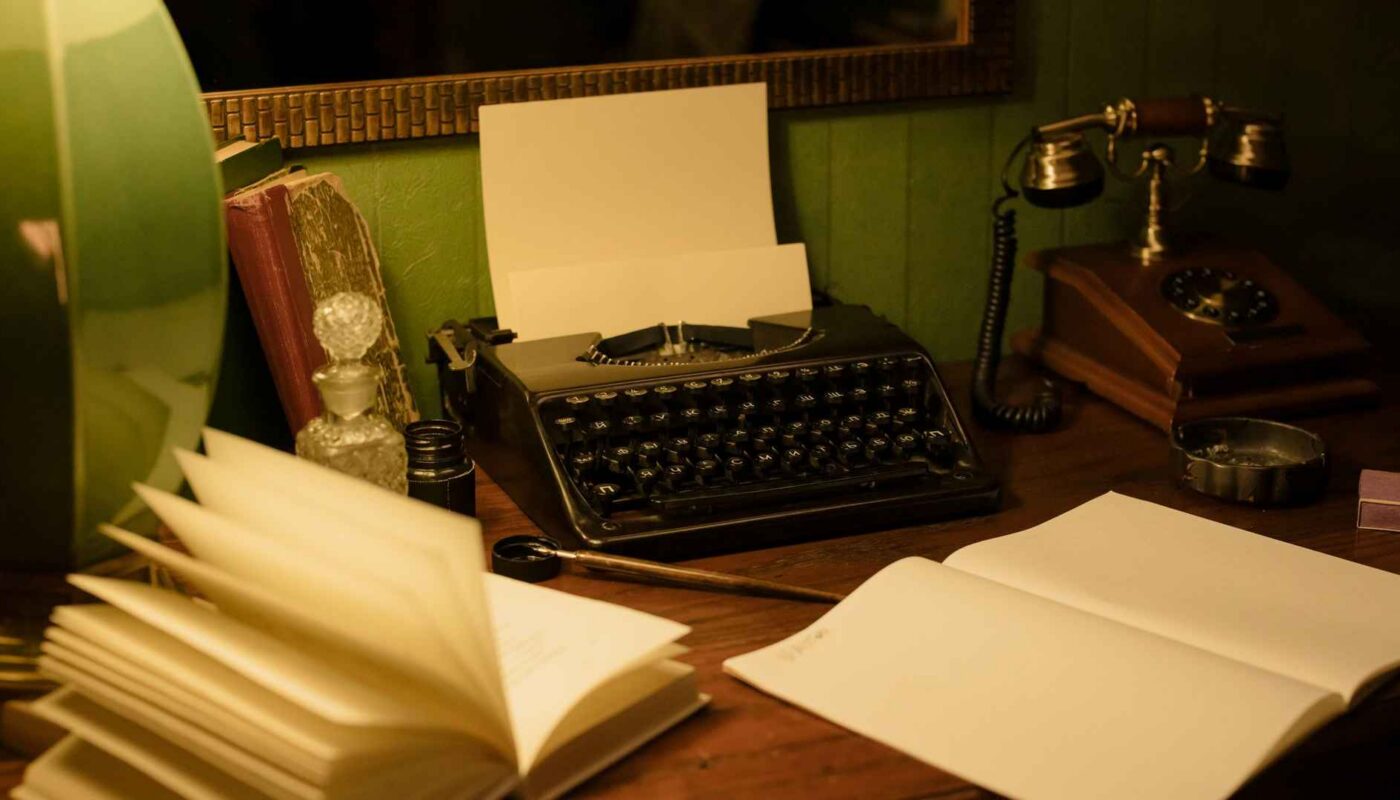
What can you do, she thinks rhetorically as she spins the chair around again, using the desk to stop herself and almost whacking the large typewriter that sits atop it. She looks regretfully at it, smoothing the shiny black keytop with her thumb. She has a computer that she keeps downstairs, and plenty of pen and paper, if she feels like it, but something about the clacking of the keys and the kind of steampunk elegance of the machine help the words flow more easily than they do when she uses anything else.
Her story is in progress, and she spies the nearly blank sheet she left in the paper lock before her phone call. It’s only a first draft, a rough outline of what her book will be, but she already feels connected to it. They’ve spent many hours together, after all. Her story is about a man named Walter. He’s a doctor of a sort. He’s not based on anyone she knows, because he is quiet and confident and knows what to say, and the people she knows are not those things. She feels her phone buzz in her pocket and knows it will be the agent, confirming more details she has been aware of for months, and she takes out the device and puts it on silent. It’s time for her to write, to be with Walter, a friend who asks nothing of her except that she bring him to life as she tells his story. She is at the part where Walter is treating one of his patients, an old woman named Mrs. Creeves. Mrs. Creeves is in fact based on someone she knows, because she is loud and insecure and often says the wrong thing. She dislikes writing this scene, because Mrs. Creeves irritates her even from within the pages, but she spins around her chair once more for luck and continues.
Walter heard footsteps in the hall and wearily realized Mrs. Creeves had arrived for her session. She was a tall, matronly woman, always concerned about something or other, and had no tolerance for looseness or informality of any sort. From her head to her feet she was always dressed in the fashion of an earlier generation, with a broad, distinguished hat and hard shiny shoes that looked incredibly uncomfortable, at least to Walter. He prided himself on his ability to talk to even the most difficult of people, but Mrs. Creeves was certainly a challenge. He sighed as he heard her loud voice, chiding him even before she had fully entered his office.
“—And of all things indeed, Doctor, your waiting room seems to be lacking even one respectable magazine! It’s all some ridiculous, frivolous nonsense, and not one issue of something suitable, like The Reader’s Digest or Consumer Reports.”
Poor Walter smiled bitterly and did his best to appease her, if only to wash away the bright flush that was rising rapidly in her cheeks.
“I’ll speak to management about it, Mrs. Creeves, and in the meantime may I suggest National Geographic? They had a very fascinating article about bats last month. Old bats, he thought privately, just like you.
“Well, all right. But let’s not dilly-dally. I’ve got places to be.”
Walter began to sort out his equipment. Not a typical doctor, he specialized in hypnosis. He had gone to medical school, but found that the life of a psychiatrist did not suit him, and so he had discovered his niche in the art of trances and persuasions. In moments of weakness he sometimes wished he could hypnotize away some of Mrs. Creeves’ crotchetiness, but he was a man of character and integrity and felt that this would be against his principles, even if it was for the greater good.
Mrs. Creeves employed him to erase certain stresses— her children rarely reached out to her and her husband had passed away in a car accident several years before. When he hypnotized her he helped her feel less lonely, and though he advised her to attend therapy for a more permanent solution, she refused. He could not complain; after all, her trauma paid his bills, and she did always leave his office with less grumbling than when she entered it.
Walter went through their regular procedure, and about thirty minutes later Mrs. Creeves departed, if not with a smile than with substantially less of a frown.
Suddenly, a loud crash jolts her from her reverie. She grimaces and rubs her forehead; the sound is familiar. The books on the overstuffed shelf in the hallway have slid off the edge once again. With a last glance at the typewriter she rises and walks to the door, shutting it as she goes.
The room is silent and airless without the clacking of the keys, like it is holding its breath. The walls are white and sparsely decorated, the carpet is beige and very clean. The desk, too, is white, and the typewriter is the only thing on it. Nothing makes a sound, the windows are sealed up tight— not even a breeze stirs the atmosphere. Yet strangely a paper rustles once, a wispy, small disturbance. Then a louder noise, a crumple, and suddenly, rapidly, the typewriter starts to swallow the paper and the keys clack and clink and type as the story begins to write itself.
Walter sat in his office, feeling resigned. Mrs. Creeves always left him feeling tired, and today she had left behind one of her hat pins as well as a piercing migraine. In truth, Walter knew that his low mood was not entirely the fault of his curmudgeonly patient. Recently, he had been losing sleep as his conscience nagged him. He had long ignored the ethical implications of his profession— changing people’s memories and personalities around felt wrong, like he was pulling strings in their stories.
The door jerks open and the typewriter keys immediately cease to press as she returns, the room stills as she arrives. She sees her phone lying on the ground, screen facing the floor, and leaves it there without regret. The chair is facing her, and she sighs as she flops into it and swings around to face the desk. Previously the picture of resolve, her interlude has sapped some of her strength, and it’s clear she’s reluctant to continue Walter’s tale as her arms hang loosely, fingers tapping the edge of the desk.
Her eyes travel slowly up, finally fixating on the sheet that’s now nearly covered in words. She blinks and squints; she’s sure she hasn’t filled a whole page, yet here it is. She skims her writing: here is Mrs. Creeves complaining about magazines, here is Walter setting up his equipment, here is Walter’s conscience nagging him— she pauses. She knows she hasn’t written this. She must have written it, but she recollects nothing. She feels her forehead, wonders if it’s warm, decides it’s not. She can’t think what would have motivated her to write this, the story is not about Walter having doubts in his profession. Walter is quiet, confident, and always knows what to say, she recollects. He does not question his decisions.
She confirms with herself that she is a rational, functioning person by taking action. She opens a drawer and pulls out a pencil sharp from lack of use, holding it carefully as she strikes through the strange paragraph, a wide X indicating that this part never happened. She puts the pencil back in the drawer, and still feeling a little uncomfortable, she shoves the drawer shut and begins to write again.
Walter sat on the couch normally reserved for patients with a sigh. Mrs. Creeves was only the first of a long line of customers that day, all with their own personal plights that demanded to be listened to. Walter had been at this job for a long time, and had watched the numbers in his bank account scroll upward at a solid rate, but as he lay on his couch with the breath sinking out of him, he realized something was wrong: he was lonely.
She pauses and rereads the section, immensely satisfied with her own work. She reminds herself not to be, that to be complacent about the first draft is to close off the possibility of improvement, even genius. But she can’t help smiling as she pictures her agent’s face. Her lonely doctor, she thinks, will sell like hotcakes. She muses, wonders what a hotcake is, makes a mental note to look it up later. She withdraws her hands from the desk and wrings them out, hearing a single knuckle crack. She shakes them, still feeling a little thrill of pleasure at her own work, before preparing to resume.
Then she hears another crack. Another, and another, her knuckles pop as if she is stretching them, but she is not. She is confused, tries to shake them, but nothing happens, like the signal from her brain to her fingers is not being received. She watches each knuckle twitch, starting at the thumb, until the pinky is reached. It crackles, vibrating and buzzing; it finds its way like a larva as she watches. She observes her hand with wide eyes; she feels her heart thud in her ribcage and her bones feel present, glued into her flesh. She stays there, frozen, not even trying to move, as her fingertip presses the delete key, the machine eating up the letters one by one, munching, striking out her work until it reaches the empty space in between her paragraphs. Then it raises, clumsily, slowly, as if puppeteered, jerking its way from key to key until new words form.
pulling strings
Suddenly she is unfrozen. She jumps backwards out of the chair, which spins a little on its axis, disturbed. She is certain she is not well, she feels wobbly and dazed, and her hands are trembling. She finds her water bottle and drinks, determined to fix herself. She feels like she’s going crazy. Maybe she’s about to die, she thinks, maybe she’s contracted some kind of rare disease. She read about a sickness in a magazine the other day— some syndrome which she can’t remember the name of. Is that what this is? She should probably quit writing for the day. She goes to pick up her phone off the floor— maybe Google will know what’s happening to her. Before she can unlock it a list of notifications flashes before her eyes, reminders about her deadline, about the various people counting on her to ‘make things happen.’ She knows ‘things’ means money. She also knows money doesn’t just happen. It has to come from somewhere, and that somewhere is going to be her novel. She’s been wasting time, she realizes. She can rest when the draft is finished. Determinedly, she resumes her writing, feeling haughty, like a martyr.
Walter sat on the couch where his patients normally sat—-
No, that’s not what she meant to say. Delete.
Walter sighed, plopping down on the couch where his patients normally—
No, wrong again. What’s going on? Delete.
Walter sat on the couch normally reserved for his patients, feeling weary and exposed. Mrs. Creeves had left a dismal atmosphere behind along with one of her hat pins.
Hat pins? she thinks, I wasn’t trying to write about hat pins.
He was feeling a little bit down. His conscience had been nagging him for a while now, it felt wrong to mess with people’s emotions and memories, like he was pulling strings in their stories. Walter was absorbed in his troubles, thinking his own, self-pitying thoughts.
What? Walter doesn’t feel self pity. He’s confident; he’s quiet.
He was so in his head that when he looked up he was surprised to find that his surroundings were entirely nonexistent.
No, no, no, no.
Except for the couch, the hat pin, and the door, nothing in the whole room had been brought into being. He knew he was in his office, he knew he worked as a hypnotist, but when he reached back he suddenly couldn’t recall the name of a single patient besides Mrs. Creeves. He didn’t know where he went to medical school, where he lived, who his family was… It was as if he had only existed for those few moments. Yet somehow, he had never noticed this before? He hadn’t thought about it. Now he was distressed, he was trapped, he didn’t understand what was happening, except perhaps, now that he thought about it, it seemed very possible that he was in a story. Like a reader, filling in the gaps of his life with his imagination, waiting to be told his own history. But this was his life!
Controlled by someone else’s hands, a doll or a puppet. Someone pulling his strings, making him dance, forcing him to deal with Mrs Creeves, stopping him from having a life outside of a tiny snapshot made for money. After all, he reflected bitterly, money doesn’t “just happen.”
There is real fear within Walter now, but not as powerful as the anger brewing inside. He wants to do something, strike something with his hands just to prove he is real. But there is nothing to strike except a couch and a hat pin and a door. He takes the pin and stabs it into his hand, and his hand crumples like it’s made of paper. He wants to hyperventilate, to shout, to yell, and so he does.
“LET ME OUT!” He screams, and it’s guttural, primitive, deeply disturbing. “LET ME OUT!”
“LET ME OUT!” she screams, and just like that she’s unbound. Her hands fly away from the typewriter, she feels so unclean, so controlled, so terrified. Her story is awake, and she sees the keys start to press again, the sheet shimmying into the paper lock happily, hungrily. In a panic she wrenches it free, feeling her heart beat as she holds the page high, her arm like a stick. The paper goes dormant and seems more gray. Then all is quiet as she releases her breath.
She stares at the wall in front of her without blinking. Perfectly still, she listens to the sound of the water running through the pipes in her house; the low whir of electrical appliances in the kitchen below. Her stare intensifies, blazing at the undecorated wall, until her stillness is broken and she snaps, letting out a trembling laugh.
She twitches— she’s afraid and she has no outlet. She glances at the paper in her hand, a thin thing. Then her fingers move, but this time she controls them. Abruptly she turns violent, her face is twisted as she tears the page into shreds that flutter down to the floor. She opens the drawer in front of her, where a stack of pages like the one now in pieces lie; she grabs them all at once and rips them neatly down the middle, the loud sound like a shout or a cry being released into the air. She leans back in her chair and breathes heavily for a moment, and then with determination drops the halves into the shredder by her desk. Her eyes water and she drops from her chair as she begins to pick up the tatters on the floor, depositing them in the shredder one by one. She flicks the switch and hears the merry grind of the machine, chewing up the papers, and then she rises, not yet finished.
She lifts her chair above her head, wheels pointing out, and with barely a sliver of emotion smashes it into the typewriter. A wheel falls off, rolling and finding a resting place next to the shredder. Juxtaposed, they’re strangely aesthetic, like a still life painting. She raises it high and smashes it into the machine again and again; keys pop off and spin through the air. She rolls her shoulder to shake the comma off of it. The paper lock slides off, the keytop is no longer smooth, instead riddled with dents. The raw destruction eases her uncertainty. The story and the tool she used to write it lie in pieces on the ground. She promises herself she will not mourn it. It was only a story, after all. And stories can’t hurt you. Can they?
Then, face still wet, she walks to the door of the room, and leaves without a sound— exits the room made of a carpet, walls, some furniture, and a great swathe of emptiness that was never described.
Eliza Basch is a high school student who lives in Chapel Hill, North Carolina. Her work has previously been published in the 1455 Literary Arts Young Poets Anthology, and she is a Scholastic Art and Writing Awards National Medalist. In her free time, she enjoys reading, playing tennis, and listening to music. She can be found on Instagram at the handle @elizabasch.